Code: 7015
Dimensions:
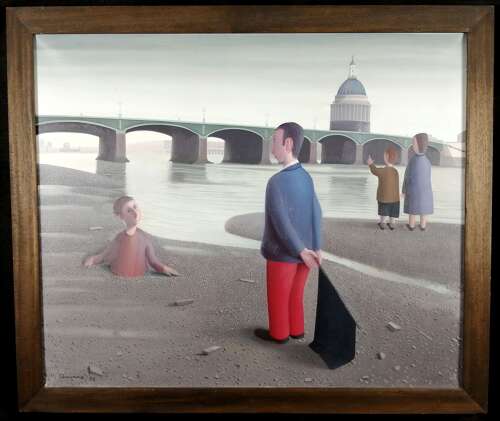
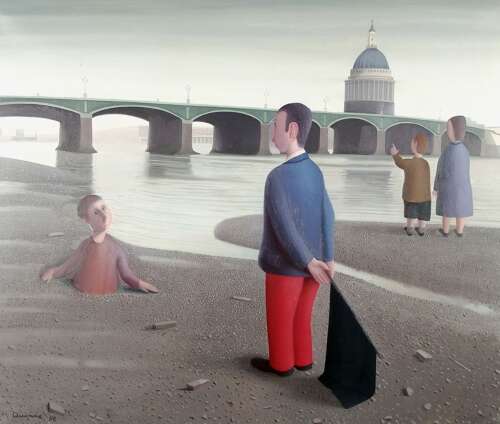
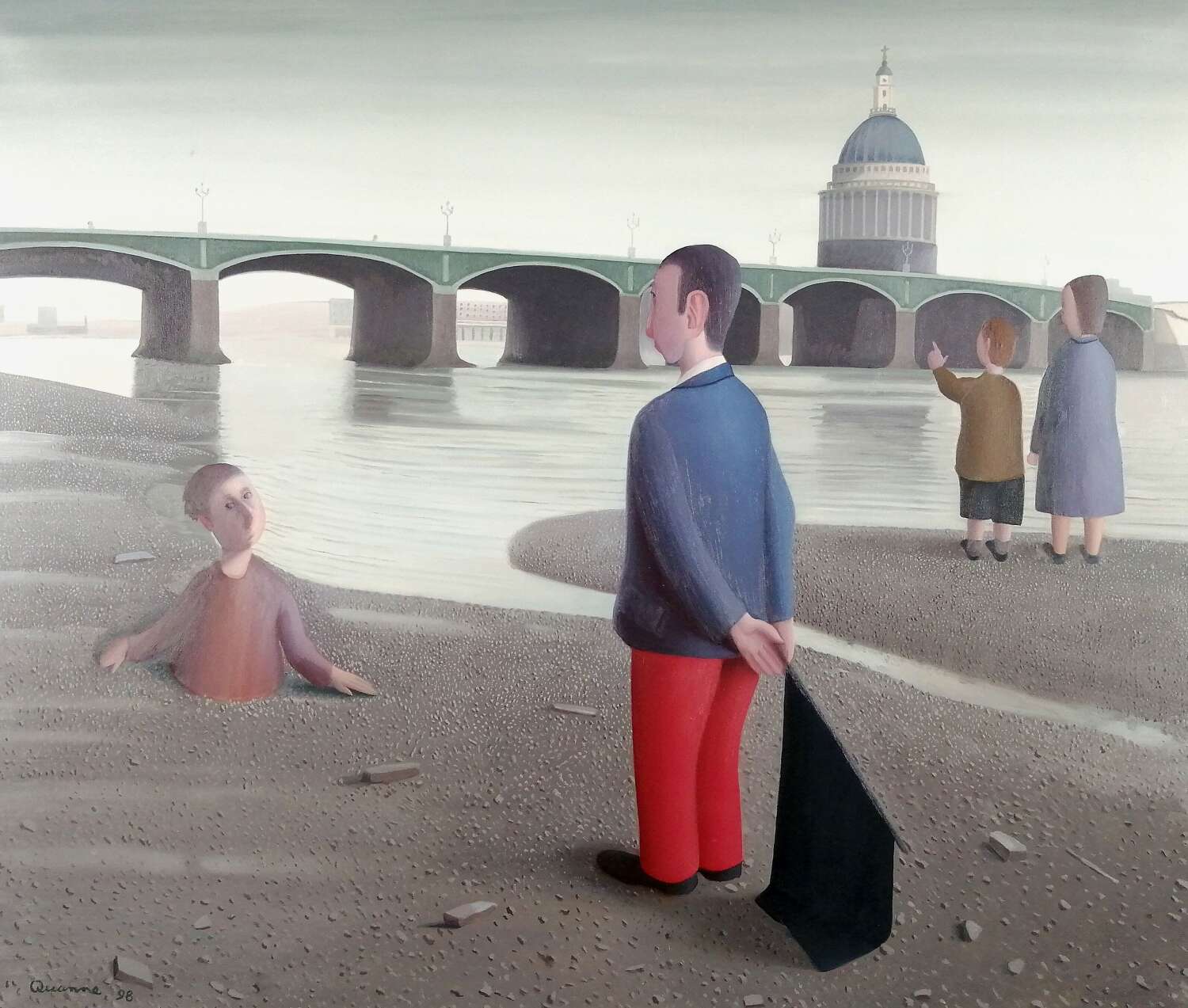
A superb and very large Postwar British oil on canvas depicting figures on the Southbank of the River Thames in London, with St. Paul's Cathedral beyond, by Michael Quanne.
By inscribing “Flag, after Jasper Johns” on the reverse, Michael Quanne brilliantly maps a national flag onto a rigid London landscape to critique state power. The bridge forms the horizontal stripes, St. Paul’s Cathedral anchors the star-filled canton, and the central man embodies the palette in bright red trousers and a dark blue blazer.
The figures remain completely isolated, most hauntingly seen in the person buried to their chest; just as Johns trapped newspaper beneath layers of wax, Quanne physically embeds a human being into the unyielding concrete of national identity. This figure serves as a powerful, silent commentary on the individuals who are swallowed up, silenced, and trapped beneath the heavy weight of institutional power.
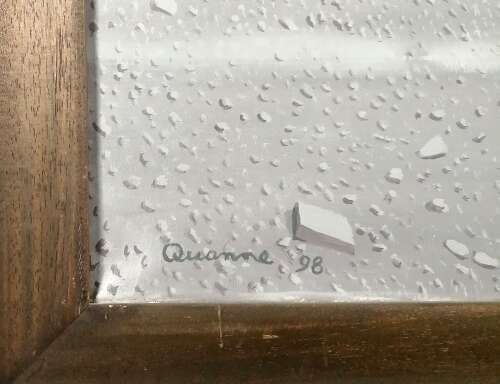
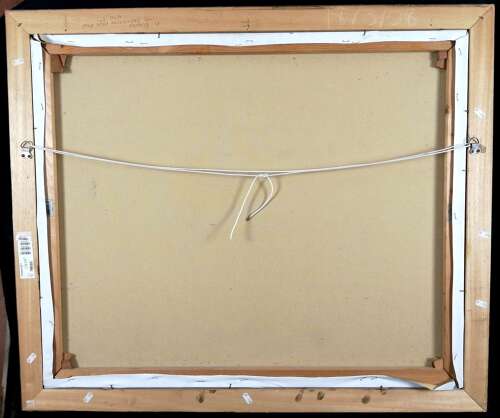
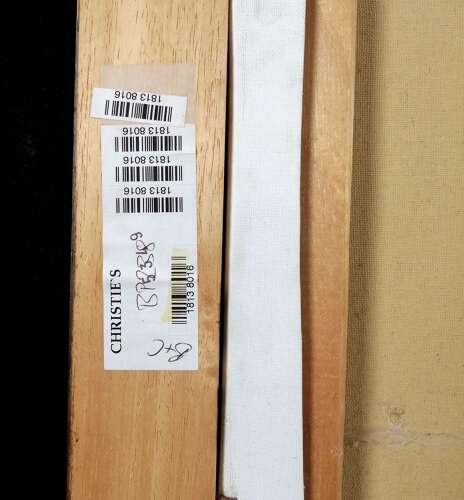
Signed and dated lower left and presented in its original painted wood frame. Christie's auction labels on the reverse and inscribed with title and artist's address in North London.
Artist: Michael Quanne (British, b. 1941)
Title: Flag, after Jasper Johns
Medium: Oil on canvas
Size: 34 x 40.5 inches (87 x 103 cm) including the frame
Michael Quanne is a Postwar and Contemporary British painter whose distinctive visual style and unconventional life journey earned him critical acclaim in the late twentieth century.
Born in Surrey, Quanne spent his formative years in Bethnal Green in London’s East End, though he was temporarily evacuated to Torquay during the Second World War. His early artistic inspirations were deeply rooted in the raw, industrial grit of East London, initially focusing on character-driven street scenes.
Quanne spent a large portion of his adult life in prison, an experience of isolation and confinement that ultimately became the primary catalyst for his artwork. Sitting in his cell, he listened intensely to music - ranging from complex recitals to the soulful melodies of Leonard Cohen - using the music as an emotional blueprint for his narrative and highly surreal paintings.
His paintings are technically rigorous, blending precise architectural framing, stark lighting, distorted geometric perspectives, and highly detailed, isolated figures to capture the psychological weight of institutional life.
His raw narrative talent caught the attention of the legendary British art critic and novelist John Berger, who heavily championed Quanne's work and wrote the introduction to his seminal 1985 book, Prison Paintings - Michael Quanne. This breakthrough led to a massive, sold-out debut solo exhibition at London's prestigious Camden Arts Centre that same year, firmly cementing his place on the contemporary British art map.
Quanne continued to paint for decades, producing poignant works, such as "Flag, after Jasper Johns", that explore the friction between institutional rules and human defiance, and his pieces remain sought after as compelling examples of Postwar British surrealism.